


For the longest time, I have had a Nintendo 64 gathering dust in a drawer. During a spring clean, however, I decided to put the console on display on a bookcase alongside my other retro games and gaming equipment. This got me wondering whether the console still worked and, if it did, whether it would be possible to use it with a relatively modern television.
Last week, I checked where I keep my old cables and found the Nintendo 64 power supply, an RCA to HDMI video converter that I had previously used with my PlayStation 2, and a Nintendo 64 SCART cable. Unfortunately, I couldn’t find a Nintendo 64 controller, Memory Pak or AV RCA cable. After checking eBay, however, I was able to pick up all three for around £20. They were all unofficial third-party accessories, but for the price, I thought it was worth a try.
The new accessories arrived earlier in the week, and thankfully, everything seems to have worked rather well. The picture is a little grainy, possibly because the RCA-to-HDMI converter is a very cheap one, or perhaps because I need to adjust the display ratio. Despite this, there is no noticeable latency, and the sound quality is excellent, making my copy of Perfect Dark immediately playable.
Unfortunately, with the exception of Perfect Dark, I gave away or possibly traded in my Nintendo 64 game collection some 20-plus years ago. However, getting the console working again has made me excited at the prospect of starting a new collection. There is also the possibility of using the same setup with a SNES (Super Nintendo Entertainment System), or Super Famicom as it was known in Japan, a console I have always wanted to own. Perhaps getting the Nintendo 64 working again will be the start of something bigger, but I am a little strapped for cash right now so can’t go crazy.
Turning on the Nintendo 64 is a refreshing reminder of just how simple gaming was back in the late 90s. Everything is essentially plug and play. There are no console updates, no game updates and, of course, no internet connection. You plug it in, turn it on and play. It is also remarkably quiet, almost completely silent, in fact. Unlike the PlayStation, which used a mechanical CD drive, the Nintendo 64 loaded its games from cartridges, so there are no moving parts involved in reading the game itself. It feels wonderfully simple by modern standards.
I have to say that, as a console, I think the Nintendo 64 was superior to the PlayStation, its main competitor at the time. One of Nintendo’s big selling points was the 64-bit architecture, compared with the PlayStation’s 32-bit. While the number of bits alone doesn’t tell the whole story about the performance of either console, it certainly became a major part of the Nintendo 64’s identity. The cartridges also had some advantages. Depending on the game, save data could be stored directly on the cartridge, while the Nintendo 64 also supported a Controller Pak for games that required one. The console also came with four controller ports as standard, rather than the PlayStation’s two, making multiplayer gaming much easier without needing an additional accessory.
On paper, the Nintendo 64 had a lot going for it. However, Sony’s PlayStation had one very significant advantage: games. The PlayStation library was considerably larger, with a huge variety of titles from both Sony and third-party developers. The console was also cheaper for consumers, which made it an attractive alternative to Nintendo’s more expensive cartridge-based system. Looking back now, it is interesting to see how differently the two companies approached the same market. Nintendo had the hardware and some truly memorable first-party games, while Sony embraced CDs, third-party developers and a much broader game library. At the time, it was an interesting rivalry, and one that would ultimately shape the future of console gaming.
It has been a long time since I played Diablo III, and for one reason or another I got the urge to play Season 39 with what have become my two favourite classes, Demon Hunter and Barbarian. The last time I played Diablo III was non-ladder back in February 2022. As for ladder, the last time was Season 23, back in June 2021.
Over the last five years or so, there have been a few new features added, which kind of surprised me. I did not think there would be any developments of any kind, even small ones, and that the game was basically in run mode, with nothing but the most minor tweaks from season to season to make them slightly different in some way. While I found the new features, namely the Altar of Rites and Visions of Enmity, welcome and fun, they have kind of made an already easy game even easier. The Altar of Rites allows you to sacrifice resources in order to gain permanent buffs, while Visions of Enmity are portals that spawn randomly, and quite frequently, taking you to an area where you can battle enemies and bosses with a very high drop rate of legendary items. At the end, there is also a fairly large amount of resources usually found in bounty caches, allowing players to do a lot more crafting without the usual hassle.
Another feature I found was that, when creating a new character, you can make it a ‘self-found’ character. This separates it from your other characters, allowing you to start over without access to a shared stash, shared artisans, resources or Paragon level. This is one feature that did not really appeal to me. I like the idea of starting over for the season, but for me, it is more fun to build on the season with as many characters as you want, sharing the resources you have gathered, Paragon levels, etc. Still, I can see why other people might enjoy it.
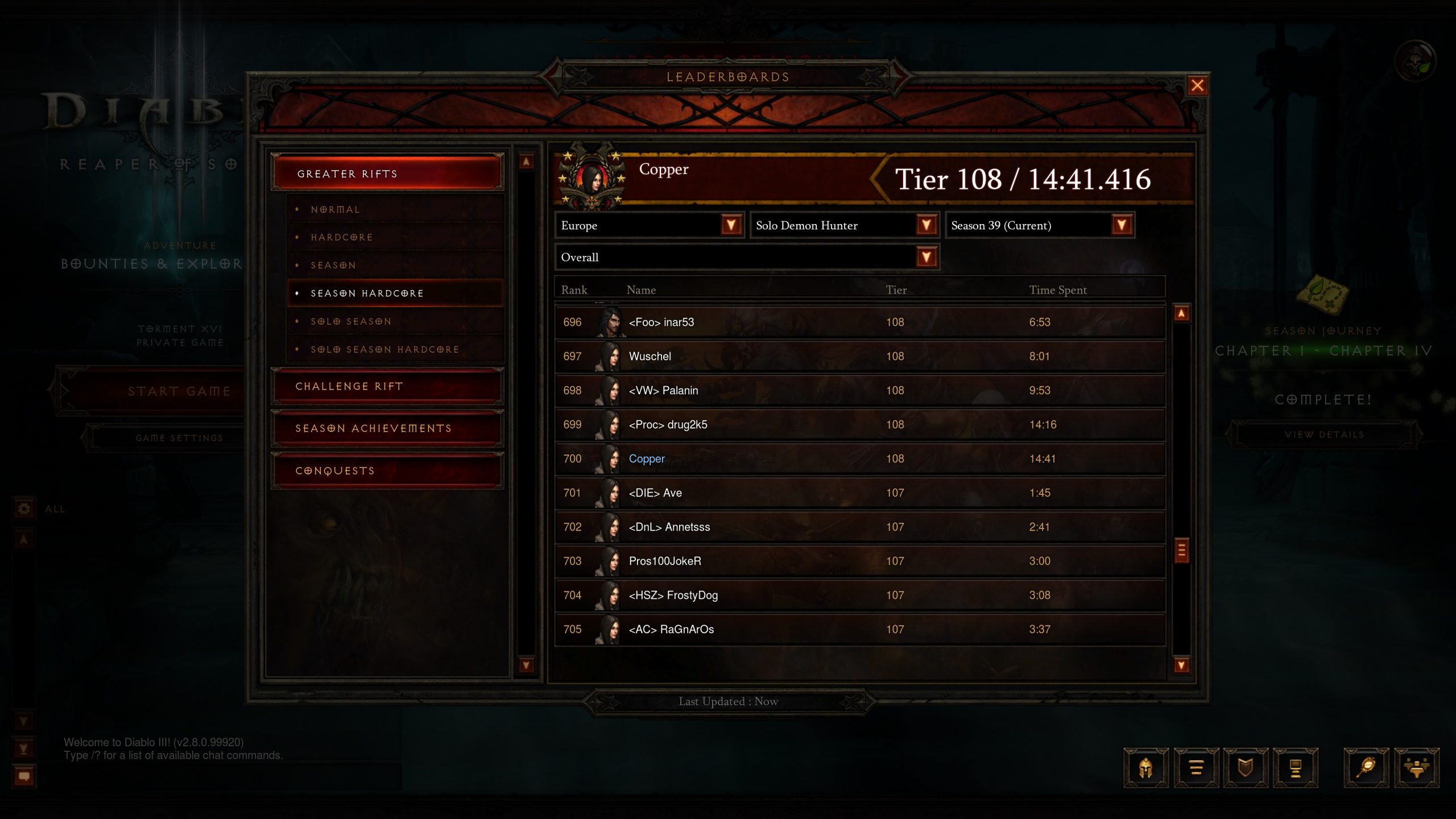
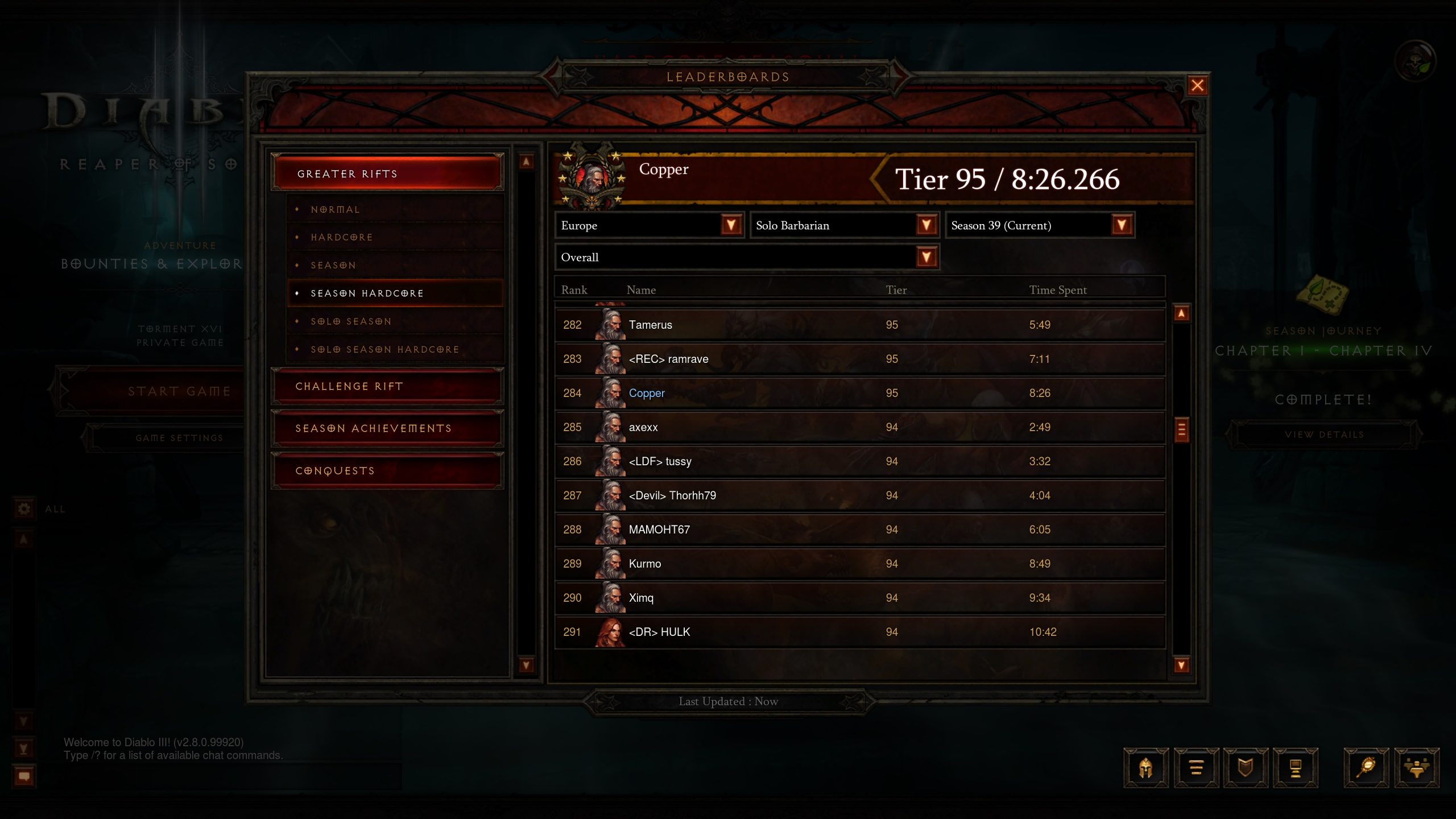
For me, there is only one way to play Diablo III, and that’s hardcore. This means that if my character dies, the death is permanent and I lose everything they were carrying. With my Demon Hunter, I managed to complete a tier 108 Greater Rift, with my previous personal best being tier 95. As for my Barbarian, I completed a tier 95 Greater Rift. Both characters are on the Solo Season 39 leaderboards, but strangely, it doesn’t feel like much of an achievement. There simply aren’t that many people playing anymore.
As well as this, I also reached Paragon level 950, which isn’t particularly impressive, but it is better than my Season 23 personal best of 841 which I am happy about. I found playing Diablo III relaxing, and I really enjoyed the progression curve. However, eventually it becomes a bit too repetitive, without any real sense that you are making much progress.
Season 39 was made even easier with the addition of Shades of the Nephalem, which are summoned each time a shrine or pylon is used. There is also an extra slot for an extracted legendary item ability in Kanai’s Cube. Both of these additions are fun, but they also make everything so much easier. Maybe it is too easy now? I am curious if season 40 with have something extra special, being a decennial season, but I doubt I will have the bug to play again anytime soon.
The time has come for the Year 8 Review of my gaming blog. Since the Year 7 Review, there have been 12 posts, eight of which have been about new games that I completed a playthrough of and added to my list of completed games.
Some of these games were pretty big titles and required a fairly significant time investment, such as Sengoku Dynasty, Dune: Awakening and Sons of the Forest. The others, Keep Digging, Front Mission 3: Remake, LEGO Star Wars: The Skywalker Saga, Warhammer 40,000: Space Marine 2 and Metal Gear Solid didn’t require quite as much time, but they certainly weren’t any less fun, I can assure you!
I still feel pleased that I have managed to turn my gaming around and play through a variety of titles, rather than being stuck in a rut playing the same thing over and over again. For a while, I felt like that had robbed me of my status as a gamer. I have to say, though, that I remain thankful to my friends who continue to encourage this behaviour!
Having said that, there was a WoW: Classic Hardcore post in February. However, I like the fact that I managed to achieve the goal I had set out to achieve and then put the game back down, rather than falling into my old habits. There was also a period of sickness in March when I suffered from epistaxis. While it wasn’t particularly serious, it did take away my desire to play games for a while.
As before, I don’t want to put any rigid goals on myself. My friends and I have invested a lot of time in playing Enshrouded, which has turned out to be an excellent game, but we aren’t finished yet. It may be that, between now and next year’s review, we won’t be able to finish what we started. However, I would like to either complete a playthrough of my own and write a follow-up post, should my friends and I carry on with it at some stage, or at least write about what we have accomplished so far.
I’m still waiting for Terminator: Survivors, which doesn’t even have a release date yet, but until then I still have some pretty big titles to play, including Baldur’s Gate 3.
If you’d like to share any feedback or suggestions about my Year 8 Review, I’d be delighted to hear from you. You can leave a comment here or get in touch by any other means that suits you.

Over the last few days, I completed a playthrough of Metal Gear Solid and added it to my list of completed games. Released in 1998, Metal Gear Solid is a third-person stealth action-adventure game with a strong emphasis on stealth. Developed and published by Konami, it is the fourth instalment in the Metal Gear series and was a massive success during the early days of the PlayStation era.
With my yearly blog review due soon, I wanted to play through a game that I thought would be relatively quick and help me end my gaming year on a high note. After noticing that the game was available on Steam, I decided it was an excellent choice and would make a great addition to my completed games portfolio. After completing the game on the Normal difficulty setting, I was pleased to receive the score shown below.
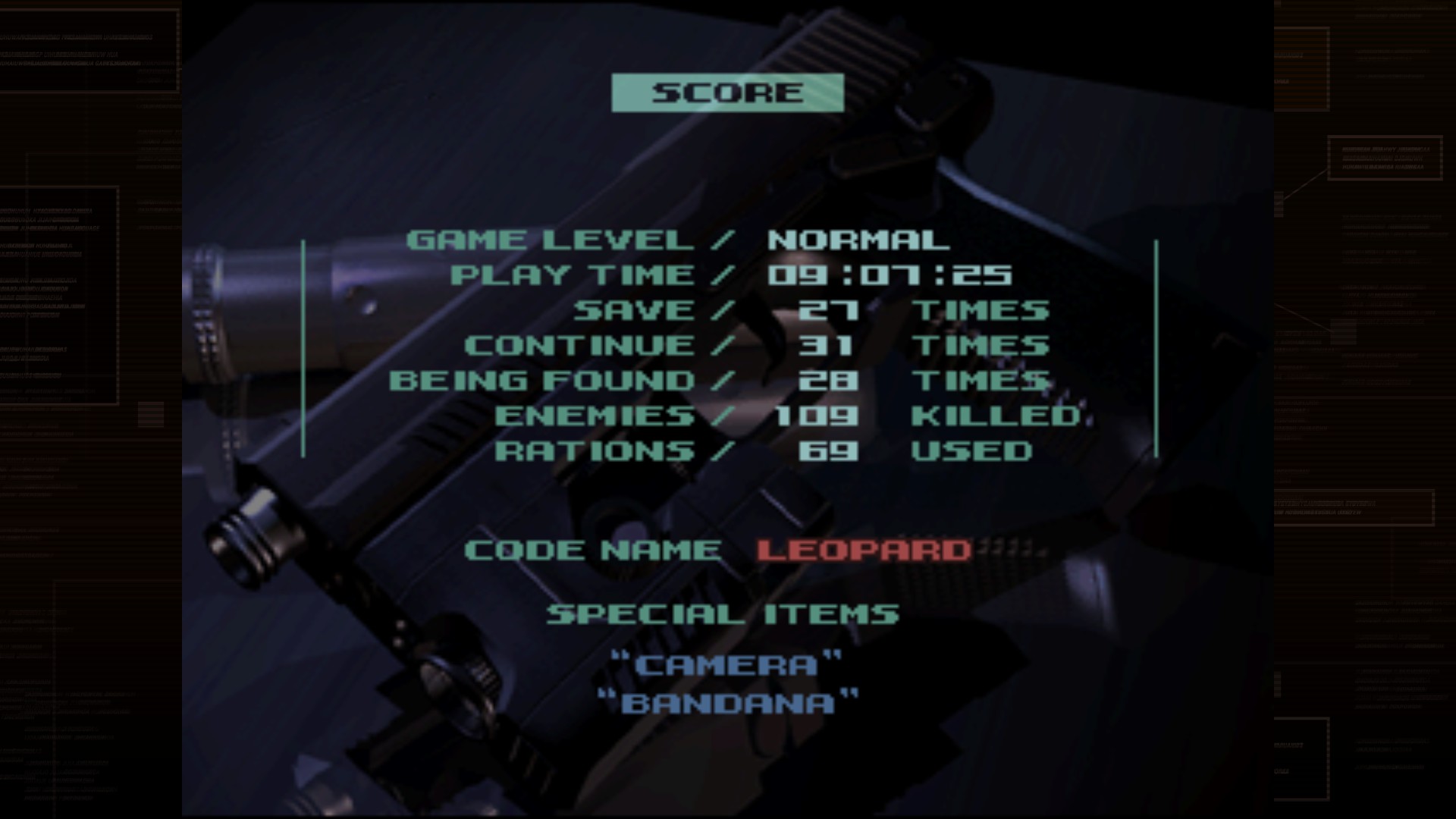
I first remember hearing about Metal Gear Solid while I was at secondary school and, as a present, my mother bought me the game for what must have been my fourteenth birthday and is still in my game collection to this day. At the time, the graphics were impressive, although today they clearly show their age. The developers experimented with some unique ideas, such as using the physical CD case to contain a clue required for progression, requiring the player to switch controller ports during a specific boss fight, and even including a camera item that allowed you to take and save first-person photographs. They also made extensive use of stealth as a core gameplay mechanic, with stun grenades, chaff grenades, cardboard boxes to hide in, and numerous other ways to distract or avoid enemies altogether. The soundtrack is excellent and the story is even better, featuring two different endings depending on one of your choices during the game. That may be commonplace now, but at the time it felt groundbreaking.
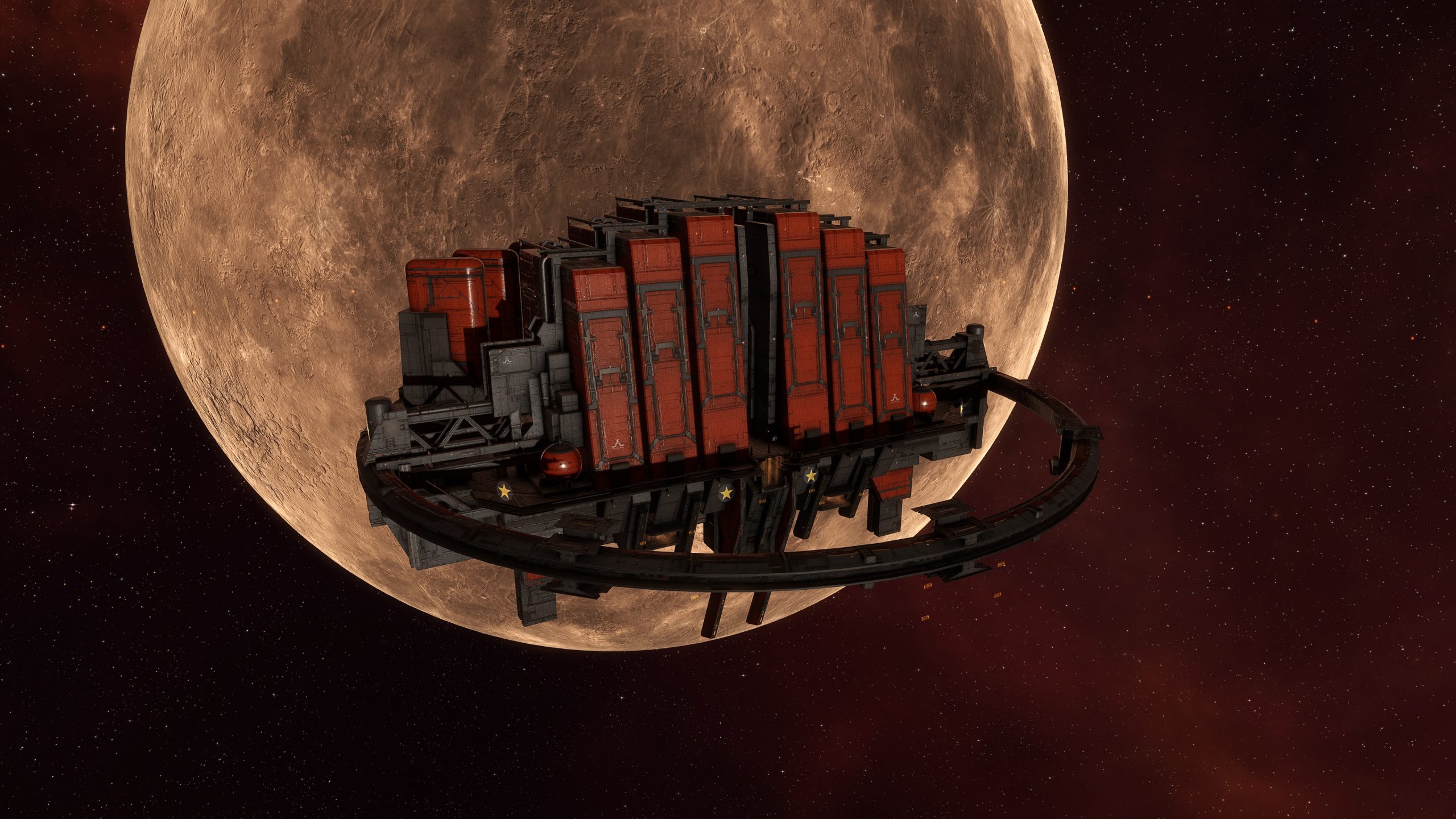
Recently I started playing EVE Online again and, more specifically, have managed to establish my own moon mining operation while introducing the game to my friend. Back in June 2025, I wrote about how I had stopped playing EVE Online, but had liquidated all of my assets so that I could start again with a fresh set of characters across two accounts. Over the last year, those characters have passively matured in terms of their skill points and capabilities, and they have remained tucked away in a quiet corner of high-security space.
However, after spending some time introducing EVE Online to my friend, I found myself wanting to play again but with a different challenge. To make that possible, I created two new accounts, allowing me to multibox four characters at a time. Since each account can have up to three characters, I decided to create two separate teams of four. The first team remains in the same sleepy, middle-of-nowhere corner of New Eden, quietly continuing its progression. The second team, which is completely independent, has been created for a much riskier, more experimental, and carefree experience, embarking on a mission to establish a moon mining operation.
Moon mining is only possible in solar systems with a security rating of 0.5 or lower. Because I don’t want to rely on other players, I am realistically limited to moons in 0.5 systems, which are still considered high-security space. From what I have seen, moons in 0.5 systems are highly contested. They are also the easiest places for suicide gankers to operate, as CONCORD’s response time is at its slowest. With that in mind, I needed to find a moon in a 0.5 system that had little competition and was unlikely to attract much attention. In the end, I chose a system that is effectively an ‘island’ surrounded by low-security space in a region that generally has a low population. This creates a different kind of challenge. Getting ships, structures, and supplies into the system carries some risk, and transporting any mined ore back out again is equally hazardous. However, I’m hoping that its relative isolation will discourage competition, and I suspect that few suicide gankers will be willing to travel through low-security space just to reach a single high-security system.
After choosing the system, I needed to visit it to get a lay of the land and survey each of the available moons. I found that there were a few regular players in the area, and while a handful of the moons were already occupied, most of those operations appeared to be inactive. That gave me the impression that there wasn’t much happening in the system and that I could probably fly under the radar. Even if the local residents did notice me, I doubted they would mind if I claimed one of the many remaining moons. In the end, I surveyed 24 available moons. There were a further 21 that I didn’t bother checking because I had already noticed a clear pattern. Every moon survey returned the same types of ore: Bitumens, Coesite, Sylvite, and Zeolites. The only difference was that some moons contained two, three, or all four of these ores in varying proportions. In EVE Online, these are all classified as ‘ubiquitous’ moon ores, so I came to the conclusion that all moons in 0.5 systems contain only ubiquitous ores, while the more varied and rarer ores are found in lower-security systems. Based on that assumption, I chose a moon that contained all four ubiquitous ores in roughly equal quantities.
Next came the risky part: moving ships, equipment, and an Athanor moon drilling station through low-security space to the island system. Before moving anything expensive, I tried to scout the route ahead. For the most part, I managed to move everything I needed to get started, including the Athanor itself. Along with the station, I transported two general-purpose haulers, four mining barges, four mining frigates, two exploration ships, and a handful of specialised haulers for transporting ore and fuel. All four of my characters have also set a jump clone in the system. This means that once every 20 hours, I can jump to another clone elsewhere in New Eden and then return the following day if I choose. Unfortunately, the move wasn’t completely without incident. I was caught in a low-security system and lost two mining barges. To be honest, it was a bit of a setback, but that’s part of the thrill of this new EVE Online adventure, so I didn’t mind too much. After moving everything into place, I discovered by chance that the station core I needed for the Athanor was being sold by an NPC station in the destination system. That saved me from having to transport one more expensive and bulky item through low-security space, reducing the overall risk.
I found anchoring the Athanor in position and getting it ready to start mining relatively straightforward. One thing I didn’t realise was that I could have started anchoring the Athanor before I had acquired the station core. Since anchoring takes 24 hours, doing this would have saved me some time, as I needed to earn enough ISK (Interstellar Kredits) to afford the station core. Once it was anchored, I was able to dock, install the station core, install the moon drill, and provide the station with fuel blocks so that it could begin operating. Now that I have a station, another corporation could potentially declare war against me and destroy it. After six days, this hasn’t happened, which I hope is a sign that nobody is bothered by my little moon mining operation and I will be left alone.
I recorded a video showing the first steps of my moon mining operation. The video shows me starting the moon drill on the Athanor and, later, returning once the moon chunk had arrived to fracture it so that I can begin mining the ore.
One unexpected bonus of the system I chose is that, occasionally, an Empire Border Rare Asteroid ore anomaly appears. These anomalies contain some Class 3 and Class 2 ores that are normally only found in low-security or null-security systems, and I have already managed to mine two of these asteroid anomalies for myself. Using the EVE Online map, I have also discovered that other Class 2 ores, such as Jaspet, Hemorphite, Hedbergite, and Gneiss, can potentially spawn. However, I haven’t seen any of these yet, and I remain slightly sceptical because I had always understood that these ores were found in anomalies within low-security space rather than high-security space. Hopefully, my assumptions are wrong, because I would really like the opportunity to mine these ores as well.
Looking ahead, there are still several challenges that I need to address, the main one being the lack of ore compression. One option would be to acquire and transport a Standup Reprocessing Facility for my Athanor. This would allow me to reprocess ore and, more importantly, compress asteroid ore, although it cannot compress moon ore. The reprocessing facility would also increase the station’s fuel consumption, so I’m not especially keen on what feels like only a partial solution. I also considered training one of my characters to pilot a Porpoise industrial command ship, as it can provide compression. However, I discovered that there is no medium moon ore compression module, only a large one, which can only be fitted to an Orca. The problem with the Orca is that the skills required to fly it are significantly higher than those needed for a Porpoise, and it is also considerably more expensive. A well fitted Porpoise costs around 300 million ISK, whereas a well-fitted Orca is closer to 2 billion ISK. Flying a 2 billion ISK Orca through low security space is a scary and incredibly risky prospect. Perhaps I could build one.
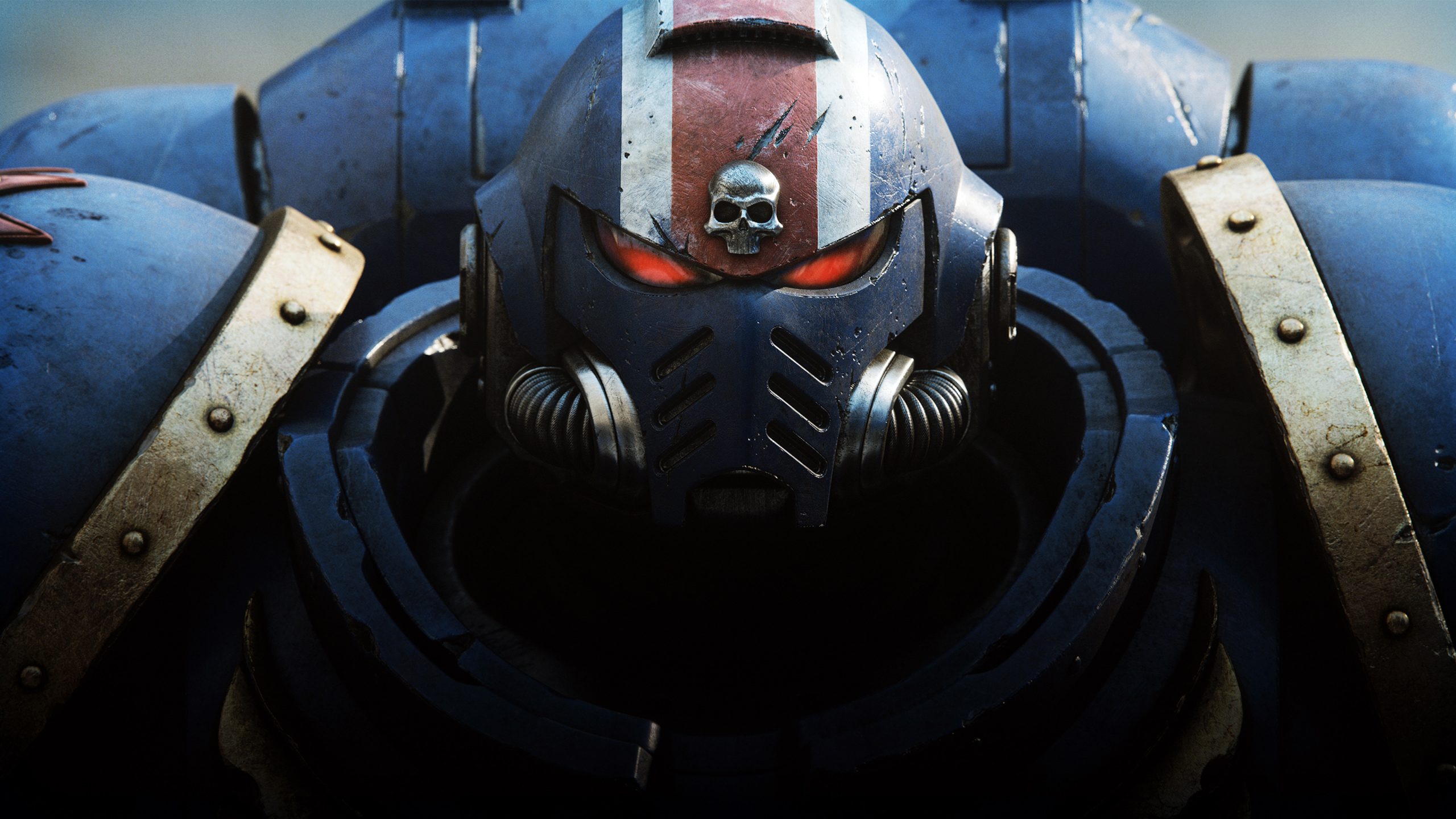
Yesterday, I completed a playthrough of Warhammer 40,000: Space Marine 2 with my friend Shadey. Developed by Saber Interactive, Warhammer 40,000: Space Marine 2 was released in September 2024 and continues the story of Titus, a Space Marine in the grimdark Warhammer 40,000 universe, where there is only war.
Whether or not you are a Warhammer 40,000 fan doesn’t really matter when it comes to Space Marine 2. It stands on its own as an excellent third-person shooter and hack-and-slash hybrid. It’s incredibly satisfying to cut through hordes of alien Tyranids while enjoying the game’s impressive visuals and atmospheric environments. The story is fairly linear, but upon completing the campaign, additional replayable PvE and PvP content becomes available. Most notable are the Operations missions, which follow a second squad of Space Marines carrying out objectives alongside the events of the main story. In addition to completing the campaign on Normal difficulty, my friend and I finished all 13 Operations on the Average threat difficulty, so I think I can safely add Space Marine 2 to my list of completed games.
By completing Operations and various other challenges, players earn experience and currency that can be used to make their Space Marine more powerful and unlock cosmetic items. I chose to play as a Space Marine from the Salamanders Chapter, purely because they are sometimes a little nicer than the average Space Marine. This is what my Tactical Marine ended up looking like.
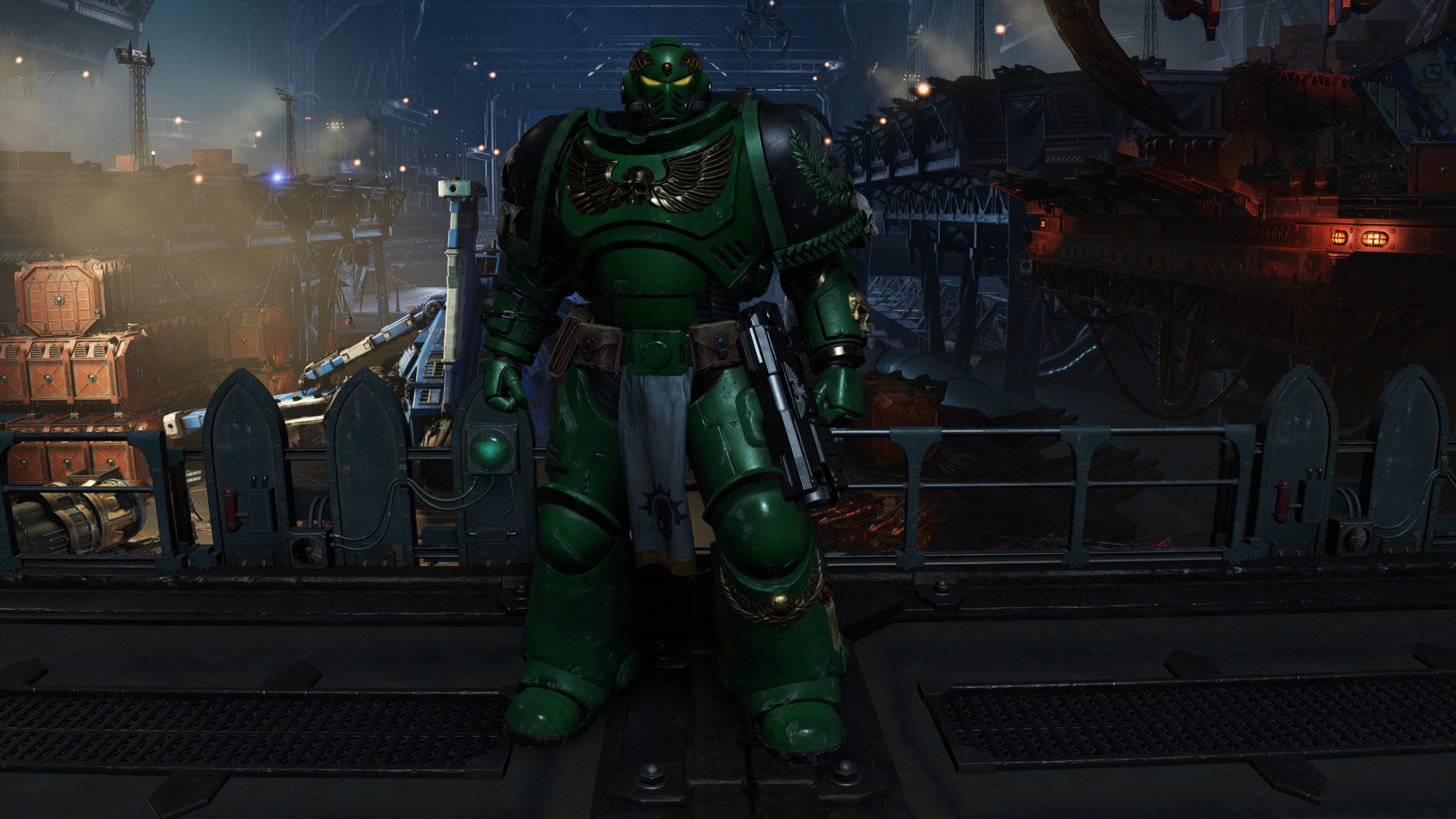
Warhammer 40,000 is a hobby that I have always respected but never really got into myself. As a teenager, some of my classmates would bring in miniatures for an after-school tabletop gaming club, which I thought looked fascinating. I was particularly impressed by the effort and skill that went into painting the models. However, at that age I was more interested in video games, collectible card games, and music, so there wasn’t much time or money left for another hobby. As a gamer however, I played Warhammer 40,000: Fire Warrior on the PlayStation 2 back in 2003, which I still think is a good game and one that remains in my collection today. I also spent some time with Warhammer 40,000: Dawn of War while searching for an alternative real-time strategy game to StarCraft, although unfortunately I didn’t enjoy it quite as much.
While there is still plenty of replayable content in Space Marine 2, such as tackling Operations on higher difficulties, experimenting with different classes, and unlocking every weapon and cosmetic upgrade, I think it’s time to take off my power armour for now. That said, I’ll certainly be keeping an eye out for future content updates, and I’ll be hoping that Space Marine 3 eventually becomes a reality.
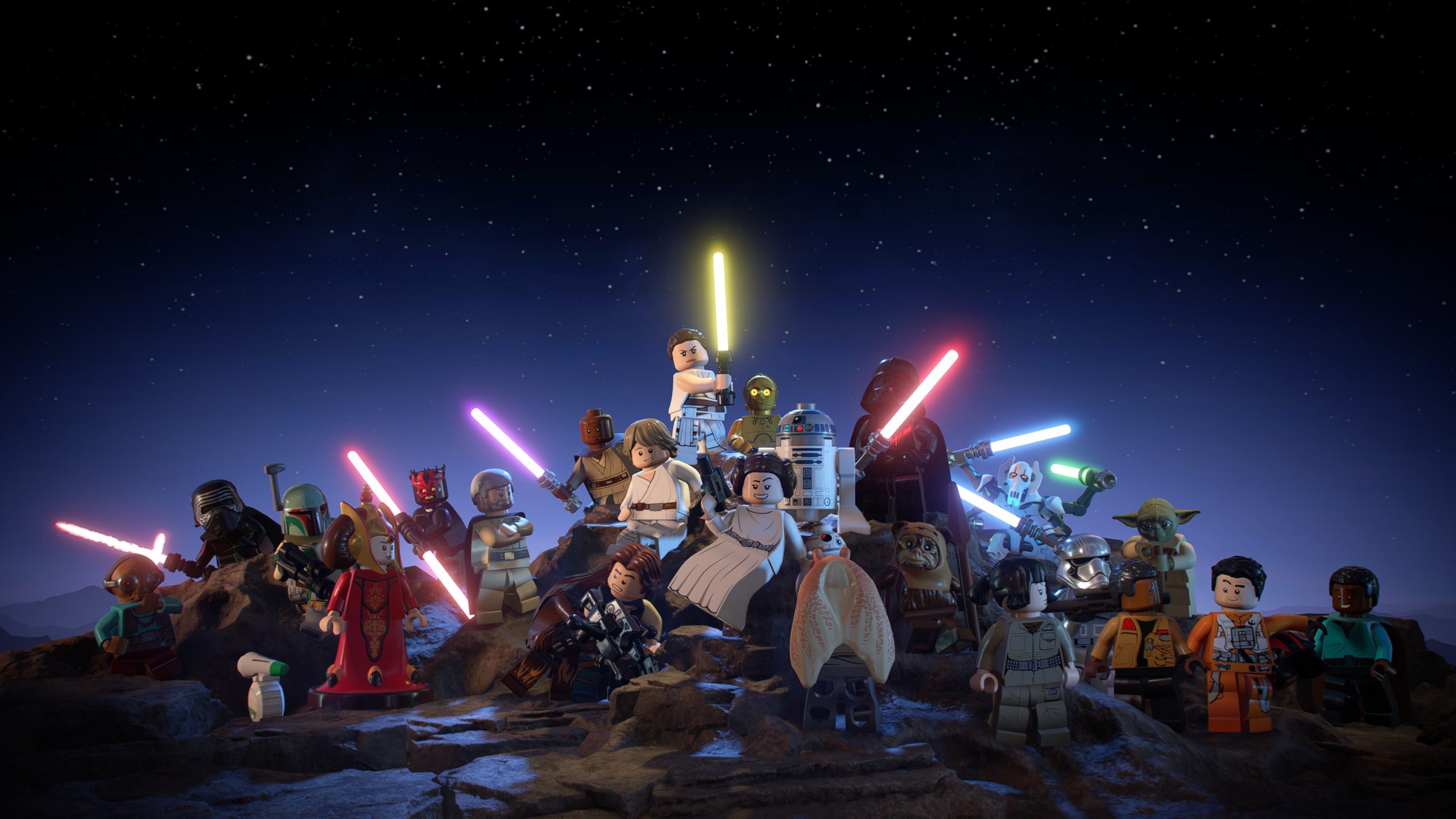
Last Christmas, my friends Jamie and Shadey gave me LEGO Star Wars: The Skywalker Saga. I started playing it soon afterwards, but decided it would be more fitting to save it for Star Wars Day and the days that follow when I usually take time off work. Today, I completed a full story-mode playthrough of the game and have added it to my list of completed games.
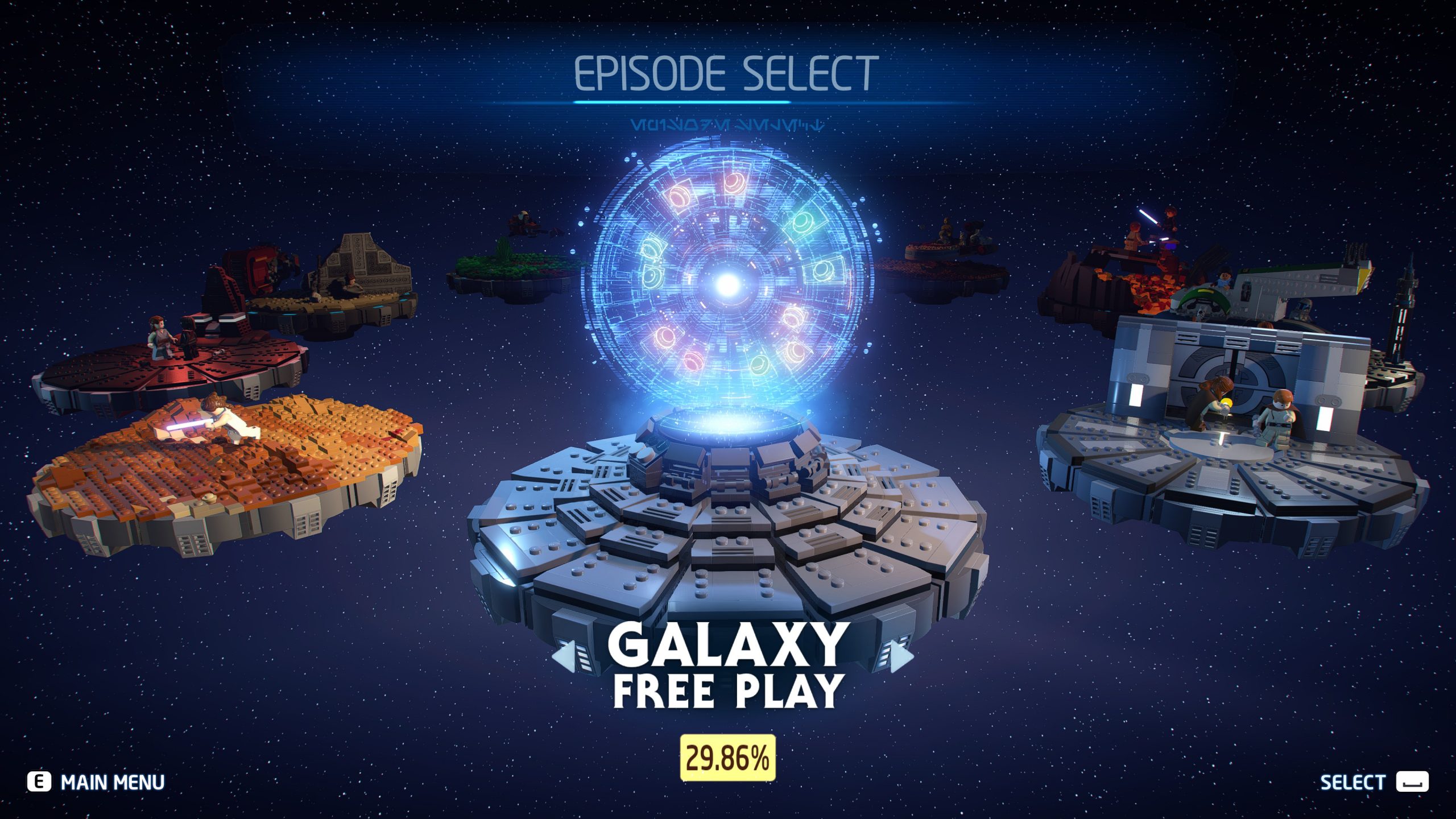
Developed by Traveller’s Tales and published by Warner Bros. Games in 2022, LEGO Star Wars: The Skywalker Saga covers the main nine episodes of the Star Wars storyline and allows players to experience each episode individually. While playing, it often felt like I was watching the films unfold, but with added humour, which I thoroughly enjoyed. As I progressed, the free-play mode for each episode unlocked alongside a variety of Star Wars characters, and I quickly realised there was a huge amount of replayable content for completionist gamers. Although I did not skip everything, I still only managed 29.86% completion in free-play mode during my story-mode playthrough.
While I will not be continuing with the free-play mode, I would still recommend LEGO Star Wars: The Skywalker Saga to any gamer who is a fan of either Star Wars or LEGO. However, if, like me, you are a fan of both, then it really is a must-have game for people of all ages. For adults, it is a great game to switch off, relax, and not take too seriously, and it is just as enjoyable for younger players as well, with its simple puzzles and humour. Even the somewhat darker or scarier scenes from the films are made light of in this game.
That just leaves me wanting to thank my friends for introducing me to yet another game and helping to bring more variety to my gaming, something I had been craving for years.
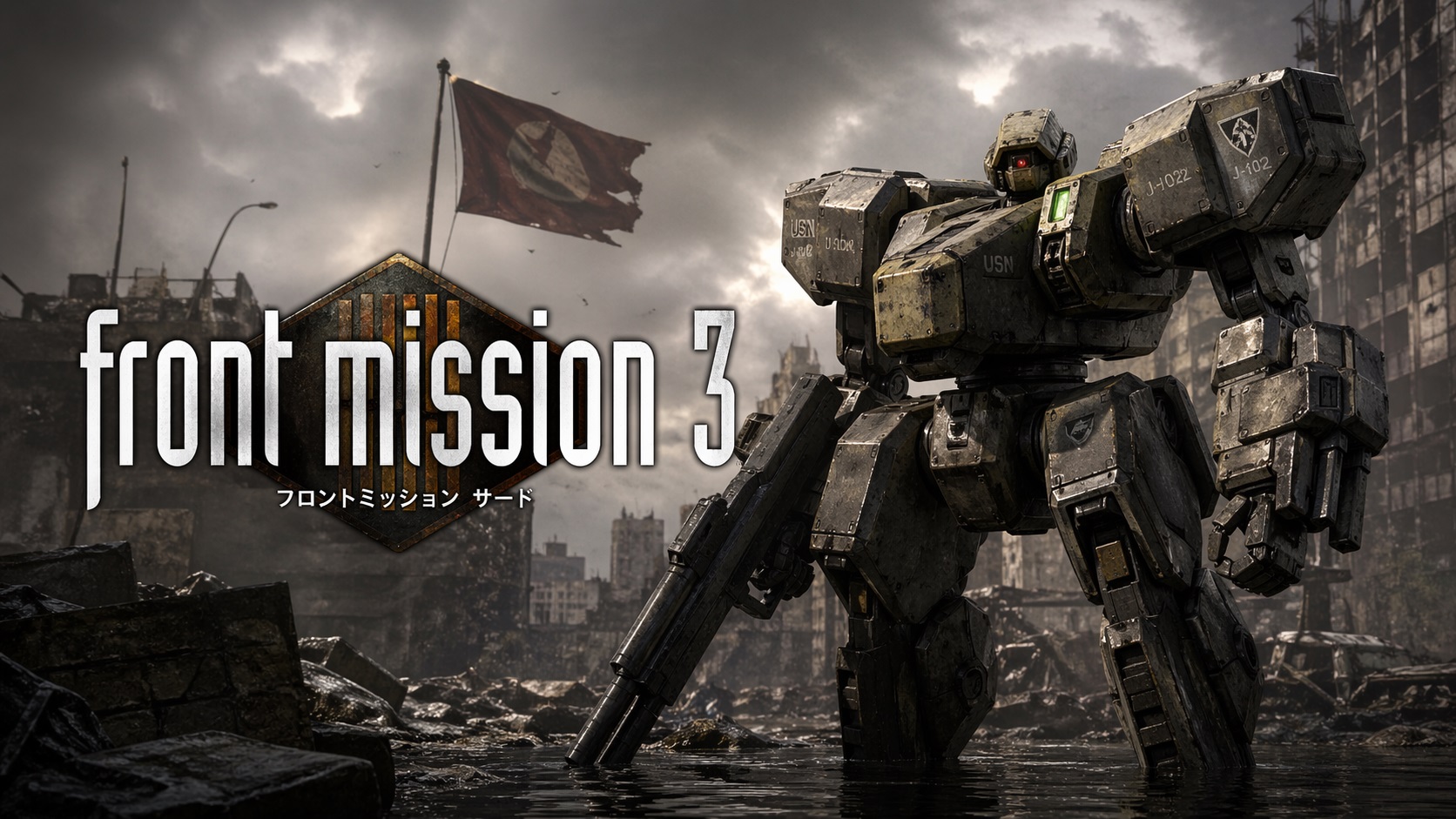
After a little over 50 hours of playtime, I have completed a full playthrough of Front Mission 3: Remake and added it to my list of completed games. I had been eagerly anticipating it ever since I learned it would be remade, alongside Front Mission 1st: Remake, which I completed in September 2023, and Front Mission 2: Remake, which I finished at the beginning of 2025.
There are two different storylines in Front Mission 3, and which one you play is determined after the tutorial. At that point, you decide whether Kazuki accompanies Ryogo (2 of the main characters) on a delivery. If you go with him, you begin the Emma storyline, where you meet Emma, who becomes your third main character. If you decide not to go with Ryogo, you instead meet Kazuki’s sister, Alisa, who takes on that role.
Regardless of which storyline you choose, the narrative unfolds through battles interspersed with dialogue, and at the end of each encounter you are awarded a medal depending on your performance. Here are the results of my playthrough of the Emma storyline.
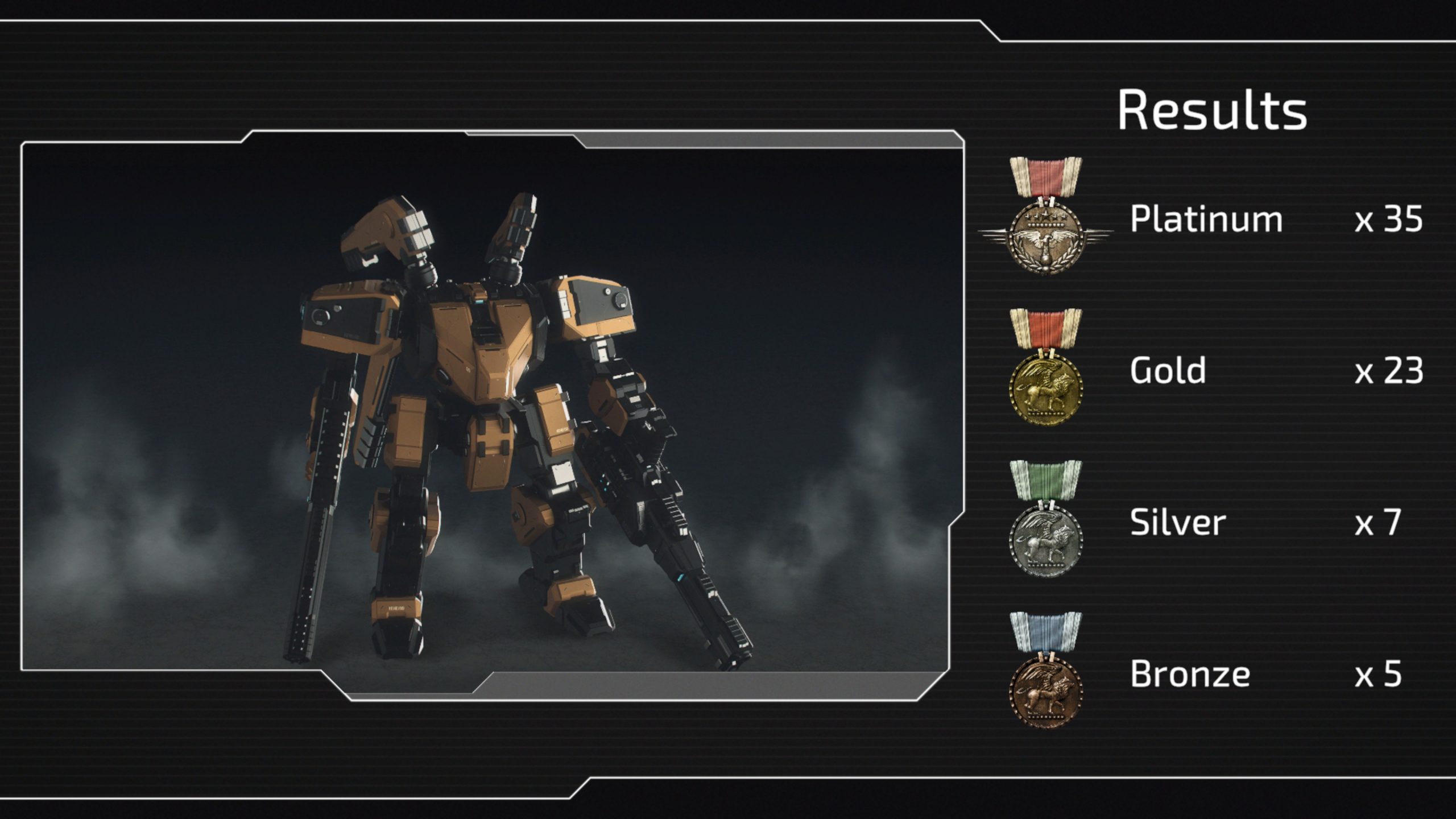
Anyone bored enough to read my blog regularly may remember me writing about completing the original PlayStation version of Front Mission 3 back in November 2021. At the time, I discovered that a cheap RCA-to-HDMI video converter and an external USB video capture card could be used to let me play my PlayStation 2 through OBS (Open Broadcaster Software). Because the PlayStation 2 is backwards compatible (arguably its best feature) I was also able to play my prized copy of Front Mission 3.
The medal results from my Alisa storyline playthrough below show that I found it more challenging than Emma’s story. At first, I thought this might be because it was only my second playthrough of Alisa’s story, but on reflection I think several of the battles are comparatively more difficult.
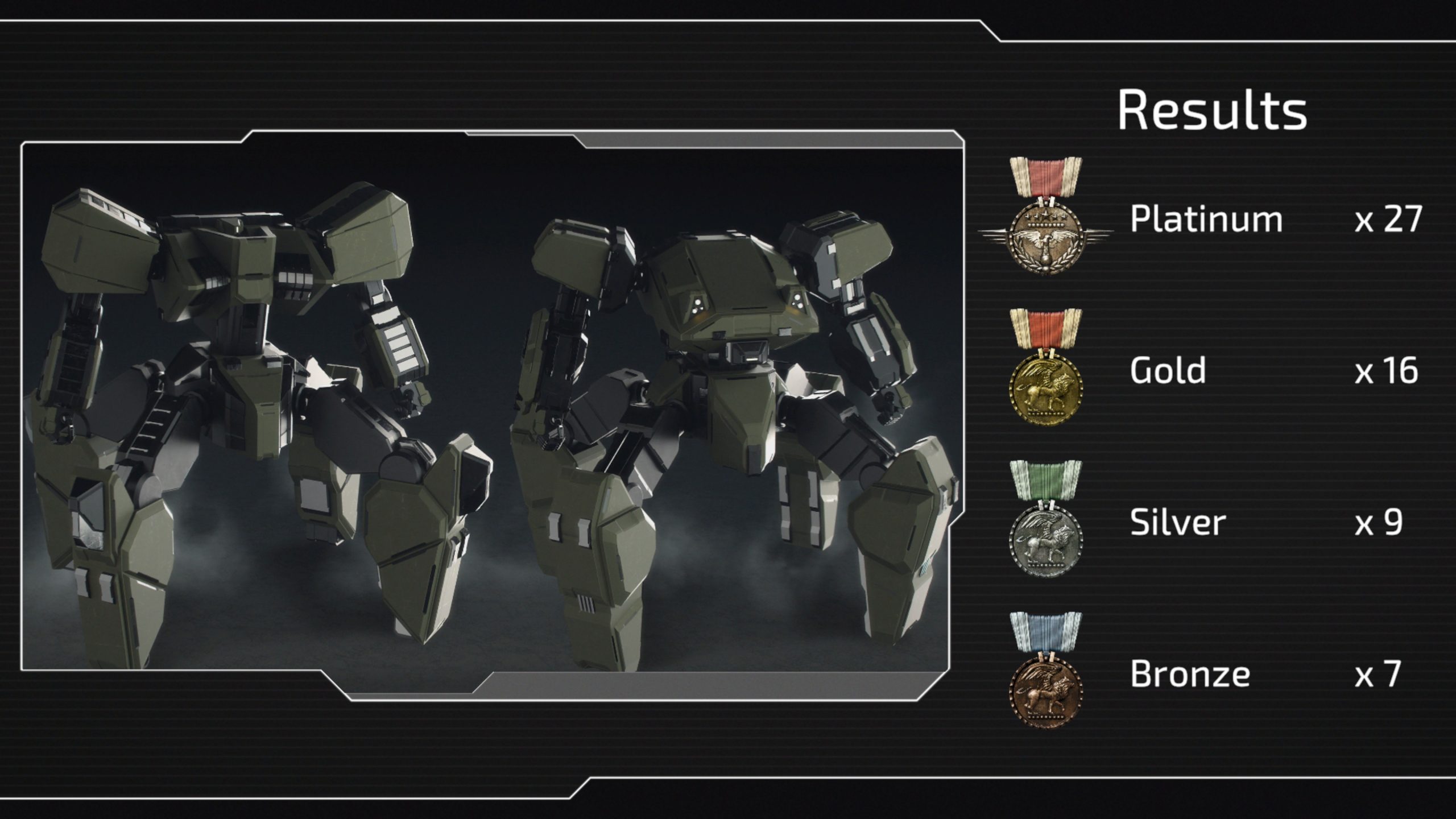
The remakes of all three Front Mission games were developed by Forever Entertainment, who will always have my gratitude for bringing them back. However, I have to say that parts of the soundtrack are, in my opinion, not as strong as the original. It’s a harsh criticism, because everything else about the game is excellent. The graphics, while far from groundbreaking, are still a significant improvement on the original; there are many modern quality-of-life enhancements; the game is, as far as I can tell, bug-free; and, most importantly, everything about it feels as it was intended to be when Front Mission 3 was originally released in the summer of 2000.
Unfortunately, there are no plans for a Front Mission 4: Remake, which is a great shame, as I have always wanted to play Front Mission 4. However, it was only released in Japan and North America for the PlayStation 2. For me to play it would require a fair amount of effort, either by modifying my PlayStation 2 or by acquiring an NTSC (National Television System Committee) compatible system.
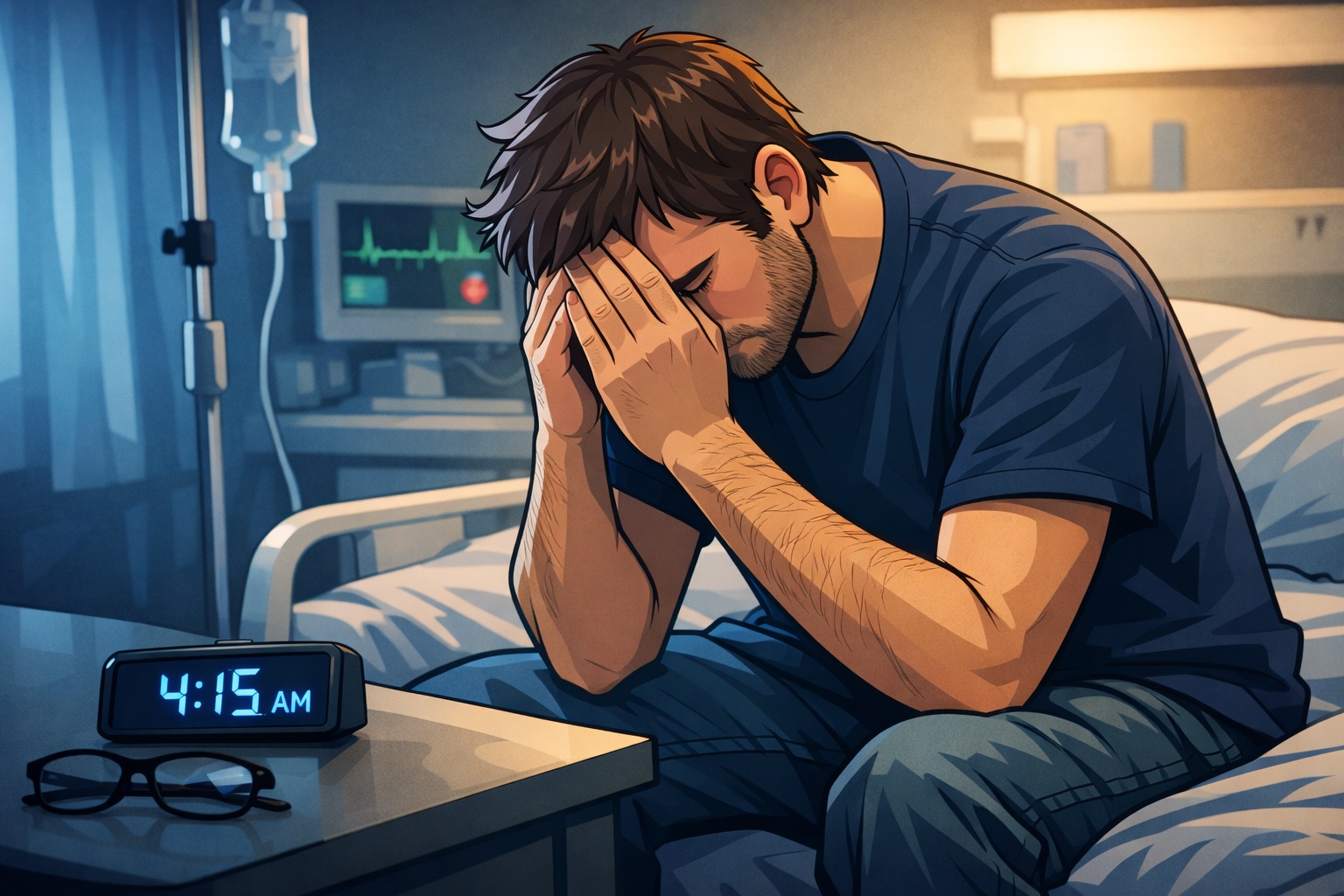
Yesterday afternoon I got home after three days and two nights in hospital with a diagnosis of epistaxis, commonly known as a nosebleed. It may seem strange, and perhaps a little embarrassing, to go to hospital for a nosebleed, but if you read on I hope you will understand. I should also add that some of the details are a little gruesome, so please stop reading if you think it might upset you.
It all started after a gaming session with my friends after work. We had finished for the day, and I was enjoying a cup of tea with my mother before bed when, out of the blue, my nose started bleeding from my left nostril. I have never had a nosebleed before, so after a short while I looked up what I should do to stop it and found some information on the NHS website. I sat up, leant forward and pinched my nose for a good 15–20 minutes, but it didn’t stop. I assumed it would stop eventually, so I went to my room to watch something while I waited and tried to follow the NHS instructions two or three more times
At around 4 am the nosebleed was still ongoing, and I started to get worried. Between the tissues and the towel I had been using, there was a lot of blood, so I called 111. For those who do not live in the UK, 111 is a first-line, non-emergency telephone number used to get advice and access appropriate healthcare. After answering all of the questions, they advised me to take myself to the A&E department (Accident and Emergency) at my local hospital. I arrived at around 4:30 am and, after triage, saw an ENT (ear, nose and throat) doctor. She said she would cauterise the bleed and then packed my nose with gauze which would dissolve in a few days. As you can imagine, it was an uncomfortable procedure, but I was happy to be seen relatively quickly and left A&E at around 7:00 am.
I hadn’t slept all night, so I decided to get a little sleep before deciding what to do about work that day. I woke up about an hour later feeling sick and was sick in the bath before I could reach the toilet. I was shocked to see that it was all blood, and a lot of it. While I was being sick, the gauze from my nose fell out and my nose began to bleed again. It was only then that I realised the bleeding had never actually stopped. Instead of coming out of my nose, the blood had been running down my throat into my stomach, which had made me sick.
My mother woke up and was even more shocked than I was, so she called an ambulance, which arrived quite quickly. The paramedics advised that it would be better for me to go back to hospital. By this time I was completely spent and exhausted. I don’t know whether it was because of the lack of sleep, the blood loss, or being sick, but I found it hard even to walk, so they took me in the ambulance.
The next 12 hours or so in hospital I can only describe as a torturous hell. Different ENT doctors, on three separate occasions, attempted the same treatment as before. I kept being sick and, eventually, the gauze would fall out. To make things worse, none of the doctors or nurses were able to fit a cannula and they found it very difficult to take blood. No fewer than four medical professionals each took turns trying to insert a cannula, until eventually a doctor using ultrasound equipment made an attempt and also failed. It was at this moment that I confess I had a mini breakdown. It was all just too much.
At roughly 10 pm, after around 24 hours of continuous bleeding, either from my nose or into my stomach, a doctor inserted a Rapid Rhino into my left nostril, which could be inflated with air to stop the bleeding. They had been reluctant to do this earlier because it would mean admitting me to hospital for at least 24 hours. Looking back, I wish they had decided to do it after the second attempt to cauterise the bleed rather than after the fourth, because it worked immediately. The procedure of inserting the Rapid Rhino into my nostril and inflating it was possibly the most painful thing I have ever had to endure. I remember crying out for mercy, and the doctor paused for a moment to let me catch my breath. It truly was excruciating. However, the blood flow did stop and no longer ran down my throat. After clearing my system of any remaining clotted blood, I stopped being sick. My nose stung and the device pushed slightly up towards my left eye, which caused quite a bad headache, but the stinging eased a little as my nose acclimatised. I was also prescribed morphine, which I could take orally.
For the next two hours I lay on a very uncomfortable stretcher with no chair, no water, no tissues, and a sick bowl that was almost full of blood. During this time the A&E department became extremely busy and was filled with hundreds of people, noise, bright lights, and virtually no attention to my basic needs. I want to make it clear that I do not blame any of the doctors, nurses, or support staff for this, nor the NHS in general. I have seen some limited improvement over recent years, but it is not enough so I support even more resources being invested in the NHS.
At around midnight, two porters came to move me to Postbridge Ward. When I got there, the lights were out and it was quiet. I had a bed with sheets and a pillow, a jug of water, a table, and a chair, and I could use a remote to request a nurse if necessary. It felt heavenly to have my situation improved so much. Don’t get me wrong, the bed wasn’t exactly comfortable, but it was a hundred times better than a stretcher and I had access to everything I needed for basic comfort. There were I think 5 other men on the ward who were, for the most part, quietly recovering like me. It was a blissful transition.
At around 10 am, ENT doctors came to see me to get an update and examine the Rapid Rhino device. They advised me that it should stay in place for another 24 hours from that point, and that an ENT doctor would come to see me the following morning to release the pressure from the device. If the bleeding had remained stopped, they would remove it completely and discharge me. If the bleeding had not stopped after releasing the pressure, however, they would inflate it again and leave it in place for another 24 hours. Even though by the next morning the Rapid Rhino would have been inflated in my nose for about 36 hours, I didn’t care. I felt like I could cope in my new surroundings, especially as I was no longer being sick, and I wanted to give the device every chance to succeed. So I didn’t argue the point.
The next 24 hours were largely uneventful. I tried to use the time to rest and use the basic comforts afforded to me. I still had little blood clots which I would occasionally spit out, which is as gross as it sounds, and I generally felt dirty, weak, fragile and I admit a little scared that the bleeding would resume when the Rapid Rhino was deflated. Around 7am an ENT doctor came to see me to release the pressure from the rapid rhino and said that a doctor would come to see me in a few hours time. The pressure release stung a little but it was short lived and if anything made it more comfortable. More importantly the bleeding did not resume. I was and to a degree still am paranoid because there is some discharge coming out which would mix with coagulated blood and give the impression that it is bleeding, but as I thought about it and examined the discharge I could see it wasn’t fresh blood.
Finally, a few hours later, a different ENT doctor came to see me and removed the Rapid Rhino. It didn’t hurt and was a huge relief. After around two more hours of observations, the doctor signed the discharge paperwork and, after being prescribed a nasal spray and ointment, I was able to go home. Both of my arms and hands are badly bruised, my nose is sore with some swelling, and I am utterly exhausted from the experience. I later found out that it was caused by the warfarin blood-thinning medication that I take after suffering a pulmonary embolism in June 2022. I have regular appointments to check my INR (international normalised ratio), which for some time has been too high and, combined with slightly elevated blood pressure, likely contributed to this happening.
For a while now, I have been playing World of Warcraft Classic Hardcore with the aim of reaching level 60. I must admit, I can almost hear my friends collectively sighing inwardly after reading the title of this blog post, because I have been trying to put my days of playing World of Warcraft behind me. Yet I have had this itch to play the Hardcore version of WoW Classic, just to see if I could do it; to see if I could reach level 60 without dying, and without trading or using the auction house, as a self-found adventurer. And yesterday, after more than 10 days playtime, some heart-stopping moments, and a great deal of patience and planning, I finally achieved my goal and reached level 60.
I first tried WoW Classic Hardcore around this time in 2023, when I wrote my WoW: February Update – Hardcore Challenge post, and later my WoW: March Update when I reached level 42. Since then, Blizzard Entertainment has released dedicated Hardcore WoW servers, and I have been wondering ever since whether I could do it.
For those who do not know what Hardcore is, it is a game mode in which, if your character dies, instead of resurrecting and carrying on, your character dies permanently and you must start again. It is not for everyone because it can be deeply upsetting to lose your progress, but I find it a fun, high-octane challenge which, combined with the self-found adventurer approach, leads to a genuine sense of achievement. I managed to capture the moment I reached level 60 with a screenshot and made a short video.
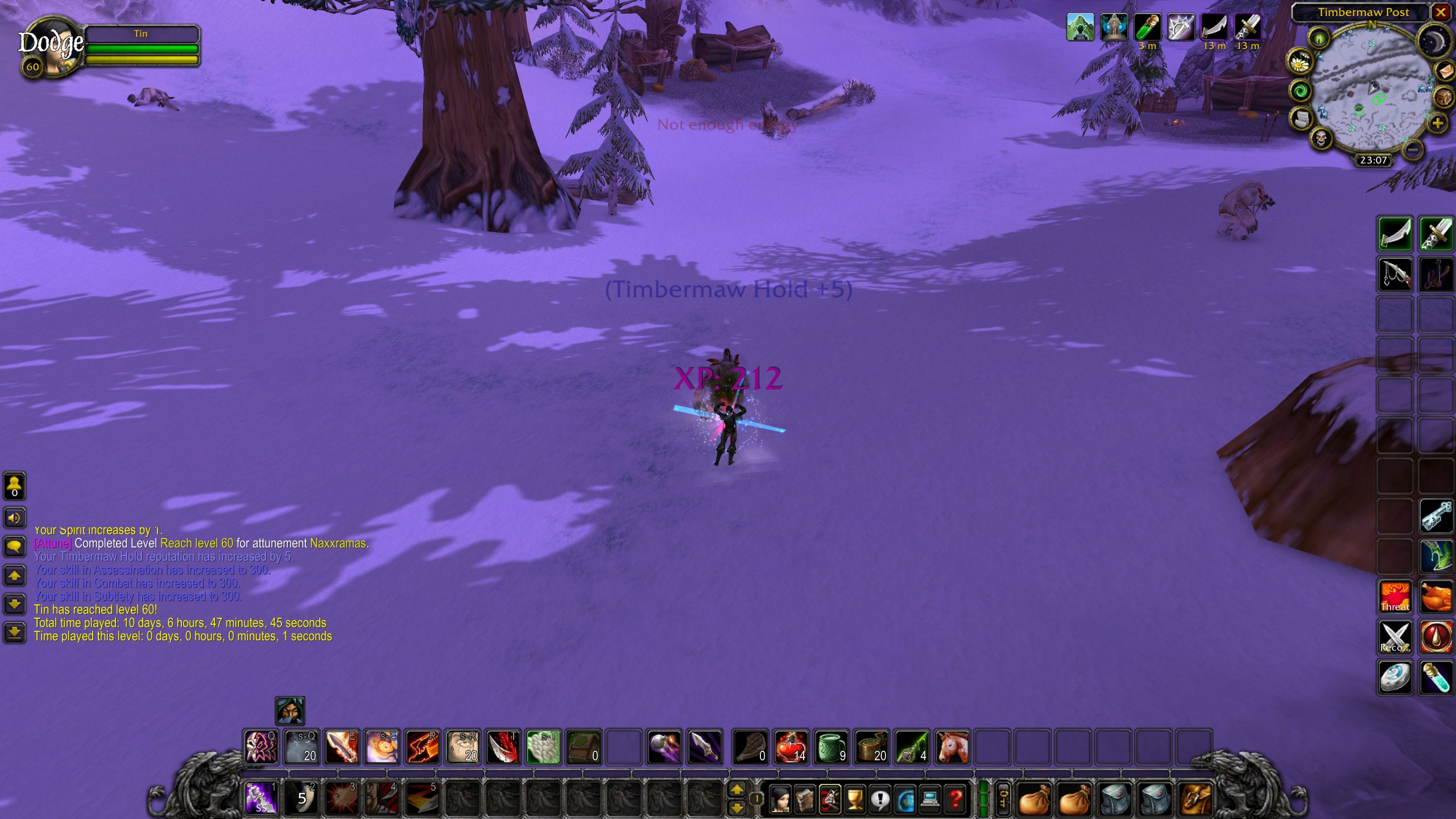
Now that I have reached the maximum level, the next logical step would be to move into the endgame by completing dungeons, raids, and certain quests to obtain the best items. But I have to admit, I am not that interested. For me, this was always about the journey: levelling from 1 to 60 without dying. Anything from here on is a bonus, and I would not even mind if my character died. I have achieved what I set out to do and do not really see the point in carrying on.
I have to say that during this journey my experience of the classic WoW hardcore community has been a positive one. Everyone I have had contact with has seemed friendly, and I even had a few people message me to congratulate me after reaching level 60, which was a lovely touch. It is almost as if the community is in it together and genuinely wants everyone to succeed. I have no doubt there are bad apples in the community, but generally speaking, it is surprisingly good.