


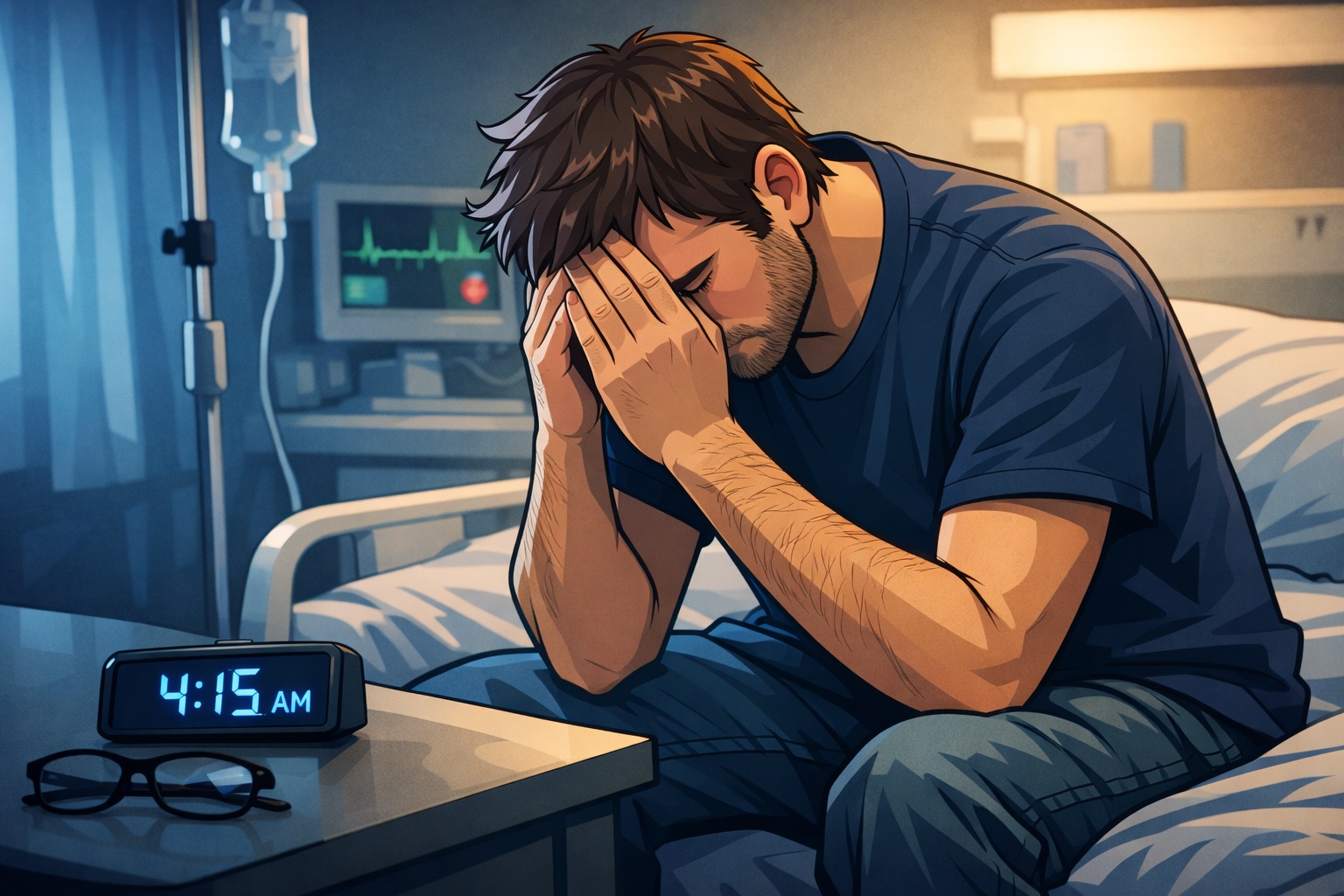
Yesterday afternoon I got home after three days and two nights in hospital with a diagnosis of epistaxis, commonly known as a nosebleed. It may seem strange, and perhaps a little embarrassing, to go to hospital for a nosebleed, but if you read on I hope you will understand. I should also add that some of the details are a little gruesome, so please stop reading if you think it might upset you.
It all started after a gaming session with my friends after work. We had finished for the day, and I was enjoying a cup of tea with my mother before bed when, out of the blue, my nose started bleeding from my left nostril. I have never had a nosebleed before, so after a short while I looked up what I should do to stop it and found some information on the NHS website. I sat up, leant forward and pinched my nose for a good 15–20 minutes, but it didn’t stop. I assumed it would stop eventually, so I went to my room to watch something while I waited and tried to follow the NHS instructions two or three more times
At around 4 am the nosebleed was still ongoing, and I started to get worried. Between the tissues and the towel I had been using, there was a lot of blood, so I called 111. For those who do not live in the UK, 111 is a first-line, non-emergency telephone number used to get advice and access appropriate healthcare. After answering all of the questions, they advised me to take myself to the A&E department (Accident and Emergency) at my local hospital. I arrived at around 4:30 am and, after triage, saw an ENT (ear, nose and throat) doctor. She said she would cauterise the bleed and then packed my nose with gauze which would dissolve in a few days. As you can imagine, it was an uncomfortable procedure, but I was happy to be seen relatively quickly and left A&E at around 7:00 am.
I hadn’t slept all night, so I decided to get a little sleep before deciding what to do about work that day. I woke up about an hour later feeling sick and was sick in the bath before I could reach the toilet. I was shocked to see that it was all blood, and a lot of it. While I was being sick, the gauze from my nose fell out and my nose began to bleed again. It was only then that I realised the bleeding had never actually stopped. Instead of coming out of my nose, the blood had been running down my throat into my stomach, which had made me sick.
My mother woke up and was even more shocked than I was, so she called an ambulance, which arrived quite quickly. The paramedics advised that it would be better for me to go back to hospital. By this time I was completely spent and exhausted. I don’t know whether it was because of the lack of sleep, the blood loss, or being sick, but I found it hard even to walk, so they took me in the ambulance.
The next 12 hours or so in hospital I can only describe as a torturous hell. Different ENT doctors, on three separate occasions, attempted the same treatment as before. I kept being sick and, eventually, the gauze would fall out. To make things worse, none of the doctors or nurses were able to fit a cannula and they found it very difficult to take blood. No fewer than four medical professionals each took turns trying to insert a cannula, until eventually a doctor using ultrasound equipment made an attempt and also failed. It was at this moment that I confess I had a mini breakdown. It was all just too much.
At roughly 10 pm, after around 24 hours of continuous bleeding, either from my nose or into my stomach, a doctor inserted a Rapid Rhino into my left nostril, which could be inflated with air to stop the bleeding. They had been reluctant to do this earlier because it would mean admitting me to hospital for at least 24 hours. Looking back, I wish they had decided to do it after the second attempt to cauterise the bleed rather than after the fourth, because it worked immediately. The procedure of inserting the Rapid Rhino into my nostril and inflating it was possibly the most painful thing I have ever had to endure. I remember crying out for mercy, and the doctor paused for a moment to let me catch my breath. It truly was excruciating. However, the blood flow did stop and no longer ran down my throat. After clearing my system of any remaining clotted blood, I stopped being sick. My nose stung and the device pushed slightly up towards my left eye, which caused quite a bad headache, but the stinging eased a little as my nose acclimatised. I was also prescribed morphine, which I could take orally.
For the next two hours I lay on a very uncomfortable stretcher with no chair, no water, no tissues, and a sick bowl that was almost full of blood. During this time the A&E department became extremely busy and was filled with hundreds of people, noise, bright lights, and virtually no attention to my basic needs. I want to make it clear that I do not blame any of the doctors, nurses, or support staff for this, nor the NHS in general. I have seen some limited improvement over recent years, but it is not enough so I support even more resources being invested in the NHS.
At around midnight, two porters came to move me to Postbridge Ward. When I got there, the lights were out and it was quiet. I had a bed with sheets and a pillow, a jug of water, a table, and a chair, and I could use a remote to request a nurse if necessary. It felt heavenly to have my situation improved so much. Don’t get me wrong, the bed wasn’t exactly comfortable, but it was a hundred times better than a stretcher and I had access to everything I needed for basic comfort. There were I think 5 other men on the ward who were, for the most part, quietly recovering like me. It was a blissful transition.
At around 10 am, ENT doctors came to see me to get an update and examine the Rapid Rhino device. They advised me that it should stay in place for another 24 hours from that point, and that an ENT doctor would come to see me the following morning to release the pressure from the device. If the bleeding had remained stopped, they would remove it completely and discharge me. If the bleeding had not stopped after releasing the pressure, however, they would inflate it again and leave it in place for another 24 hours. Even though by the next morning the Rapid Rhino would have been inflated in my nose for about 36 hours, I didn’t care. I felt like I could cope in my new surroundings, especially as I was no longer being sick, and I wanted to give the device every chance to succeed. So I didn’t argue the point.
The next 24 hours were largely uneventful. I tried to use the time to rest and use the basic comforts afforded to me. I still had little blood clots which I would occasionally spit out, which is as gross as it sounds, and I generally felt dirty, weak, fragile and I admit a little scared that the bleeding would resume when the Rapid Rhino was deflated. Around 7am an ENT doctor came to see me to release the pressure from the rapid rhino and said that a doctor would come to see me in a few hours time. The pressure release stung a little but it was short lived and if anything made it more comfortable. More importantly the bleeding did not resume. I was and to a degree still am paranoid because there is some discharge coming out which would mix with coagulated blood and give the impression that it is bleeding, but as I thought about it and examined the discharge I could see it wasn’t fresh blood.
Finally, a few hours later, a different ENT doctor came to see me and removed the Rapid Rhino. It didn’t hurt and was a huge relief. After around two more hours of observations, the doctor signed the discharge paperwork and, after being prescribed a nasal spray and ointment, I was able to go home. Both of my arms and hands are badly bruised, my nose is sore with some swelling, and I am utterly exhausted from the experience. I later found out that it was caused by the warfarin blood-thinning medication that I take after suffering a pulmonary embolism in June 2022. I have regular appointments to check my INR (international normalised ratio), which for some time has been too high and, combined with slightly elevated blood pressure, likely contributed to this happening.
Leave a comment